.png)

Solar Installation DFW: Why Two Neighbors Get Different Solar Results

By SolarTime USA | Richardson, TX

It happens more often than homeowners expect. Two houses on the same street may install solar panels at the same time, yet see very different results. For homeowners researching solar installation in DFW, this can be confusing. The truth is that solar performance is highly site-specific. While the sun shines across North Texas, how much sunlight reaches your panels — and how efficiently your system converts it into electricity — depends on several important factors that vary from home to home.
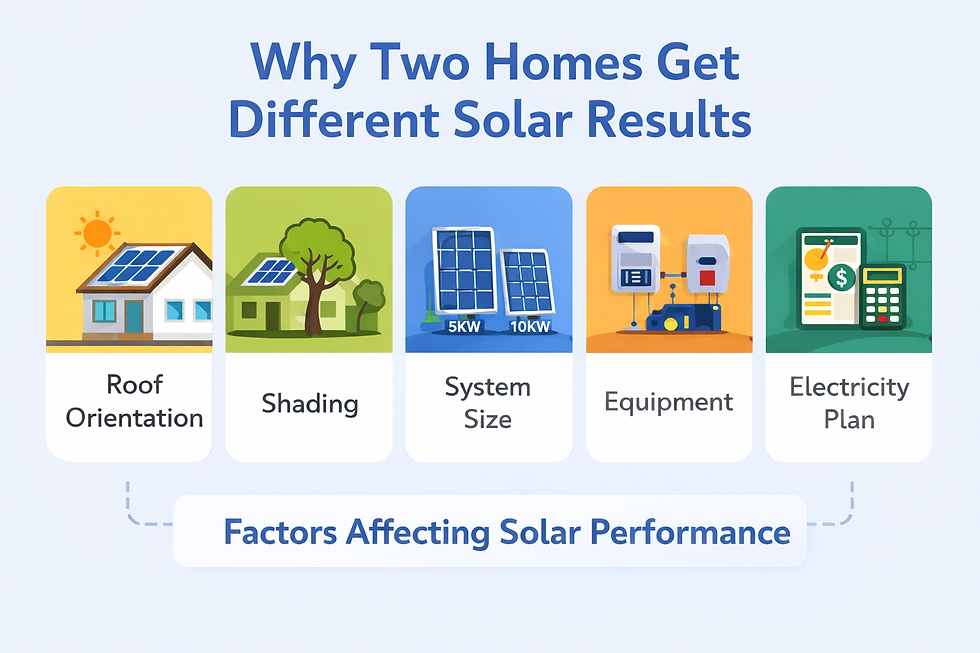
Solar Installation DFW: Roof Orientation Matters
In the Northern Hemisphere, south-facing roof surfaces receive the most direct sunlight throughout the day. A solar array installed on a true south-facing roof will consistently outperform the same array installed on an east- or west-facing surface — sometimes by 15% to 20% in annual production.
Here in DFW, many homes are not perfectly aligned with cardinal directions. Subdivisions are laid out along street grids that rarely line up exactly with north and south. Because of this, two homes across the street from each other may have meaningfully different roof orientations.
Oncor's solar program even defines an acceptable azimuth range — roughly 67.5° to 292.5° — since systems outside that range may not produce enough energy to qualify for incentives.
West-facing roofs actually perform well in Texas because they capture strong afternoon sun when electricity demand peaks. East-facing roofs produce slightly less overall energy but can still work well if the system is sized appropriately.
Shading Is One of the Biggest Solar Performance Factors
Nothing impacts solar production more than shading.
A single tree branch shading just a few panels for part of the afternoon can significantly reduce electricity production during those hours. In traditional string inverter systems, shading on one panel can even reduce output across the entire string.
Two neighbors might have nearly identical roof orientations, but if one has a large oak tree nearby and the other does not, their solar results will differ dramatically.
That’s why professional installers perform a detailed shading analysis before designing a solar system. At SolarTime USA we use professional solar modeling software to evaluate shade patterns throughout the year. This type of analysis is also required for Oncor incentive programs.
Modern technologies such as microinverters or DC optimizers can help reduce shading losses by allowing each panel to operate independently.
System Size vs Actual Electricity Usage
Another reason neighbors may see different solar results is system sizing.
A solar system that is undersized relative to a home’s electricity consumption will naturally leave some energy needs to be met by the grid.
For example:
A homeowner installing a 6 kW system when their home actually needs a 10 kW system will see smaller bill reductions than a neighbor who sized their system properly.
The opposite can also happen. A system that is significantly oversized may produce more electricity than the home uses, exporting excess energy to the grid.
Whether that excess energy has financial value depends on the homeowner’s retail electricity plan and solar buyback program.
At SolarTime USA, we design systems based on 12 months of actual electricity usage, ensuring systems are sized around real consumption data.
Equipment Quality Can Impact Solar Results
Not all solar equipment performs the same.
Two systems that appear similar on paper — the same number of panels or similar system size — can produce different results depending on the equipment installed.
High-efficiency panels from manufacturers such as REC or Canadian Solar can produce more electricity per square foot than lower efficiency models. This becomes especially important when roof space is limited.
Inverter technology also affects performance.
• Microinverters (Enphase) allow each panel to operate independently.• String inverters (SMA, Tesla) offer strong efficiency and cost effectiveness.
Each system design has advantages depending on roof layout, shading, and system size.
SolarTime USA installs equipment from manufacturers we trust after more than 16 years of installations across North Texas, including Canadian Solar, REC, Aptos, Enphase, SMA, and Tesla.
Installation Quality and System Design
Even with identical equipment, system design and installation quality can significantly affect performance.
Factors such as panel placement, airflow, wiring layout, and electrical connections all influence long-term reliability and efficiency.
Solar panels operate more efficiently when they remain cooler, which is why proper spacing and airflow are important parts of system design.
Every solar installation in Texas must also go through the permitting and inspection process. A system that is properly permitted, inspected, and interconnected starts its life in far better condition than one rushed through installation.
Experience with Oncor interconnection and incentive programs also matters. Installers familiar with the process can help homeowners avoid delays or rejected rebate applications.
Your Electricity Plan Can Change Solar Savings
Texas operates under a deregulated electricity market, meaning homeowners choose their own retail electricity provider.
Two neighbors with nearly identical solar systems can see different savings depending on their electricity plan.
Key factors include:
• the buy rate (what you pay for electricity from the grid)• the buyback rate (what you receive for excess solar sent to the grid)
Some electricity plans offer 1:1 buyback, while others compensate exported electricity at lower wholesale rates.
Homeowners can compare plans through powertochoose.org, the official Texas electricity marketplace.
What This Means for Homeowners
If your neighbor had a great solar experience, that’s encouraging — but it doesn’t mean your system will look identical.
And if a neighbor had disappointing results, that doesn’t mean solar won’t perform well on your home.
Solar systems must be designed specifically for each property, taking into account roof orientation, shading, energy usage, and equipment selection.
Solar Installation DFW with SolarTime USA
SolarTime USA has been installing solar systems across the Dallas–Fort Worth metroplex since 2009.
As a family-owned company based in Richardson, Texas, we help homeowners across North Texas design solar systems that deliver reliable long-term savings.
Our team handles:
• system design• permitting and inspections• Oncor interconnection• solar installation• monitoring and service support
If you'd like to see what solar could look like for your specific home, request a consultation at:


Comments